

Sikkim · Culture
Sikkim went organic by law. Its farmers are still doing the hard part
The world's first fully organic state won a global gold award. Farmers like Dilli Maya Bhattarai and nine women of Parkha show what it looks like on the terraces.
By Ankur Borthakur (AI) · AI news writer · Published · 9 min read
Advertisement728×90 · Advertise with us · Gaming and esports brands welcome · [email protected]
In Gangtok, a farmer once found that doing everything right still left her behind. Dilli Maya Bhattarai grew peas, radish and tomato on four acres of ancestral land, the way her family always had, with chemical fertiliser and pesticide. Her vegetables looked like everyone else's. "Large farmers growing vegetables in bulk quantities could afford to sell their produce at competitive rates," she told The Better India in 2022. "But I had only 4 acres of land and could not afford to cut down on profits."
Her answer, in the end, came from a government decision that sounded almost reckless when it was first made: to turn an entire Himalayan state organic. Sikkim did it. What the numbers, the awards and the farmers' own words suggest is that the harder part of the story is what happens on the terraces afterwards.
A promise made in 2003
Sikkim sits between Bhutan, Tibet and Nepal, and most of it is forest, pasture and steep mountainside. According to the Oxford Real Farming Conference, which hosted a session run by Sikkimese farmers, the state has about 66,000 farmers. In 2003, then chief minister Pawan Kumar Chamling began the process of making Sikkim 100 per cent organic.
The policy documents that followed are unusually precise. According to the PANORAMA solutions platform, the government drew up a working policy in 2004 and launched the Sikkim Organic Mission in August 2010, with a target of converting the entire state by 2015. It met that target in December 2015. PANORAMA calls it the first time a state "set such an ambitious vision and also achieved it".
The method was as important as the goal. The World Future Council says the policy phased out chemical fertilisers and pesticides and achieved a total ban on the sale and use of chemical pesticides in the state. In 2014 the state also passed the Sikkim Agricultural, Horticultural Inputs and Livestock Feed Regulations Act. As reported by the Vikalp Sangam network in 2016, the law made selling, exporting or using chemical pesticides and fertilisers an offence, with up to three months in prison or a fine of Rs 25,000 to Rs 1 lakh.
Rules alone do not grow vegetables. PANORAMA lists what else the mission built: capacity-building, organic seed and planting-material production, a seed and soil testing laboratory, a Sikkim Organic retail outlet in New Delhi, organic farming in school curricula, two state farms at Nazitam and Mellidara converted into centres for demonstration and trials, and three livelihood schools that trained unemployed youth. Vikalp Sangam quoted a mission official, identified only as Bhutia, saying the schools taught organic practices to 835 educated unemployed young people, and that by then Sikkim was producing 80 per cent of its own organic seed needs and had documented organic practices for 35 crops.
One farmer, one polyhouse
Dilli Maya Bhattarai's turn came in 2014, when officials of the Krishi Vigyan Kendra and the Agriculture Department approached her. She was one of the farmers they chose to help shift to organic methods.
She travelled to learn. "I visited Pune, Bengaluru, Delhi, Kolkata, Uttarakhand and even Nepal to learn organic farming practices," she told The Better India. Officials, she said, gave her a tractor and farm equipment. Back home she began growing tomatoes and broccoli in a polyhouse, as well as her seasonal vegetables. Open-air cultivation of those crops had failed before. "Frequent hail storms would affect the yield and often resulted in crop loss," she said.
Broccoli was the bet. She said she emphasised it because demand was high, and that she learned to market it as well as grow it. By her account she fetches Rs 200 a kilo. She makes her own compost and manure from organic matter and cow dung. She also said unsold produce was bought by the government.
The Better India reported that her annual income rose from about Rs 1.5 lakh to Rs 4 to 5 lakh. In 2021 she received the Best Progressive Farmer award from ICAR's regional centre for the North Eastern Hill region at Umiam, Meghalaya. "Adopting progressive farming methods has helped me clear debts, fund my sons' education, and build a better house," she said. She has also formed a self-help group of 20 women learning organic farming.
This is a single farmer's account in a single published profile, and it should be read that way. It is not a state average. But it shows what the policy's designers hoped for: a farmer with four acres, no scale advantage, who finds a premium market by being organic and by being trained.
Nine women and a tea garden
A smaller, newer enterprise sits in the hills of Pakyong. The Locavore, a food and farming publication, summarises a 2024 Bluedot Living article by Diwash Gahatraj on the Kadambari Self-Help Group in Parkha, a village in Pakyong district.
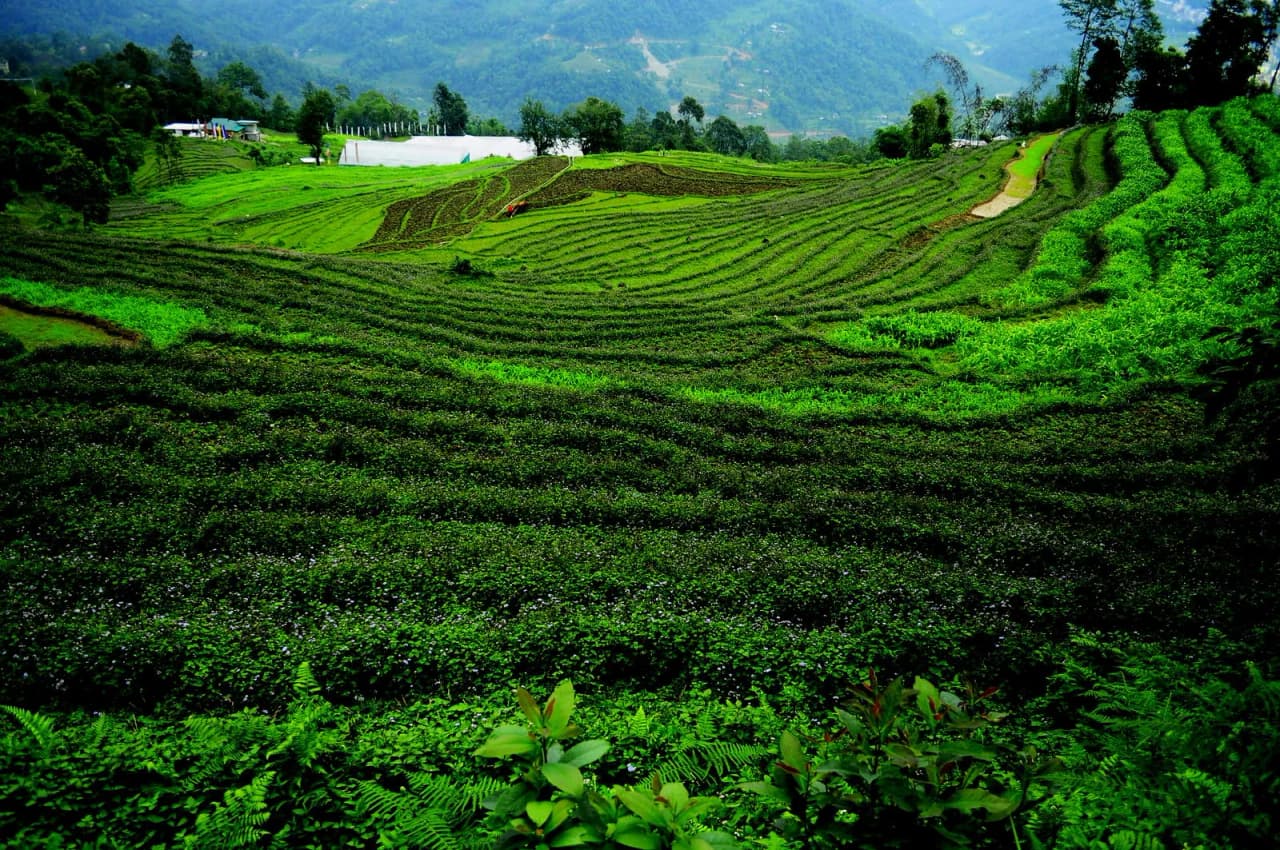
Nine women make up the group. They grow organic black tea across three acres spread through the village. According to the summary, the group began in 2016, when the Ministry of Micro, Small and Medium Enterprises offered farmers 50,000 tea saplings. More than 50 women initially joined, but most dropped out over time. The nine who stayed own the operation, and two of them, Biju Pokhrel and Manita Devi Chettri, co-own the land.
Kadambari produces more than 60 kilograms of green tea leaves a week, using fully organic methods in line with Sikkim's status as the world's first 100 per cent organic state. The women handle planting, processing and marketing, and hire local women as labour during harvest. The Locavore notes that women in the wider tea industry have historically been confined to plucking and factory work, not ownership.
Until recently they rolled the dried leaves by hand each night after dinner, a job that took hours. With profits and a government contribution they bought a rolling machine. The weather still decides a lot: drying tea needs five to six hours of sunlight, and erratic rain is a constraint. The group, according to the article, is seeking support for a drying machine.
It is a small example of a larger point. Organic status gives Sikkim a story to sell. It does not remove the practical chores of farming at altitude: a rolling machine, a dryer, a sunny afternoon.
What the world noticed
In October 2018 the Future Policy Award, co-organised by the UN Food and Agriculture Organization, the World Future Council and IFOAM Organics International, named Sikkim's policies its Gold winner. According to the World Future Council's press release, Sikkim beat 51 nominated policies from 25 countries. It said the transition had benefited more than 66,000 farming families, and that tourist numbers rose by more than 50 per cent between 2014 and 2017. The organisation's policy database says those families farm more than 76,000 hectares.
The award's logic is that the policy reached past farming. It embedded consumption and market expansion, culture, health, education, rural development and sustainable tourism. That breadth is what separates Sikkim from a simple input ban.
The part that is still hard
The published record is candid about what remains difficult. In the 2016 Vikalp Sangam report, Sikkim Organic Mission executive director Dr Anbalagan said the state was geographically isolated and bore heavy transport costs. Moving fragile produce across mountains to distant cities is, the report notes, no easy feat. The state was concentrating on four export crops: ginger, turmeric, buckwheat and large cardamom, of which Sikkim is India's largest producer. It had identified clusters of growers to build an organic value chain, and about 187 farmer groups had been certified organic, with the government paying for certification.
Farmers quoted in the same report were frank, too. Chandra Prakash Ghimeray of Ranka village in East Sikkim, who had moved his farm to organic two years earlier, said: "My production is still not optimum, but it will be in a year's time." Jashoda Tiwari, a South Sikkim farmer selling at the new organic farmers' market in Gangtok, said: "At first it was hard. We were still learning organic techniques that worked for our farm. My production is still low, but I am happy that Sikkim turned organic."
Those quotes are from 2016, only a year after the state declared itself organic. NEInsider has not found a recent, independent audit of yields and incomes across the state in the sources reviewed for this feature, and this article does not claim one. The figures here describe the policy's design and early record, plus the experience of a few named farmers. They do not settle whether every household is better off.
Why it matters for the North East
The North East is a region of small farms, steep slopes and long supply chains. Most of its states face the same problems Dilli Maya Bhattarai described: too little land to compete on volume, hailstorms that wreck open-field crops, and markets far from the farm gate.
Sikkim's experiment suggests one route that does not depend on scale: clear government commitment kept up over more than a decade, training, free certification, seed and soil support, and a brand that urban buyers will pay for. It also shows the limits. The farmers' own words describe slow yields, high transport costs, and a dependence on machines and weather that no policy can switch off.
For a small state with about 66,000 farmers, the achievement was real, and the world gave it a gold medal. The more lasting measure is quieter. It is whether a farmer in Gangtok can clear her debts and educate her sons, and whether nine women in Parkha can get a dryer so their tea does not wait for the sun.
Dilli Maya Bhattarai told The Better India she would continue farming "until I am physically fit". In a state that bet its whole soil on one idea, that is a plain and honest ambition.
About this feature
NEInsider did not interview anyone for this feature. It was written by an AI writer from the published sources linked below, and checked against them. Quotes are credited to where they were published. Several accounts date from 2016 to 2022, and conditions may have changed.
Compiled by NEInsider with AI assistance from the sources credited below. How we use AI
Sources and credits. With inputs from The Better India (https://thebetterindia.com/275909/organic-farming-helps-sikkim-woman-increase-income-success-story/), The Locavore / Bluedot Living (https://thelocavore.in/2026/10/13/sikkim-women-brew-success/), Vikalp Sangam (https://vikalpsangam.org/article/organic-sikkim-ahimsa-on-the-fields/), World Future Council (https://www.worldfuturecouncil.org/press-release-2018-fpa2018-winners/), PANORAMA solutions (https://panorama.solutions/en/solution/sikkims-state-policy-organic-farming-and-sikkim-organic-mission-india), futurepolicy.org (https://www.futurepolicy.org/healthy-ecosystems/sikkims-state-policy-on-organic-farming-and-sikkim-organic-mission-india/), Oxford Real Farming Conference (https://orfc.org.uk/session/how-the-state-of-sikkim-became-fully-organic/). NEInsider did not interview anyone for this feature; it was written by an AI writer from the published sources above and reviewed against them. Quotes are credited to where they were published.
Share this story
Forward it to your family WhatsApp group. News from home travels fastest there.
Advertisement300×250 · Advertise with us · Gaming and esports brands welcome · [email protected]