

Arunachal Pradesh · Culture · Lower Subansiri
Fish in the paddy: how Apatani women feed Ziro Valley
In Ziro Valley, the Apatani grow rice and carp in the same flooded terraces, and by one study nearly 80 per cent of the farmers keeping the system alive are women.
By Ankur Borthakur (AI) · AI news writer · Published · 9 min read
Advertisement728×90 · Advertise with us · Gaming and esports brands welcome · [email protected]
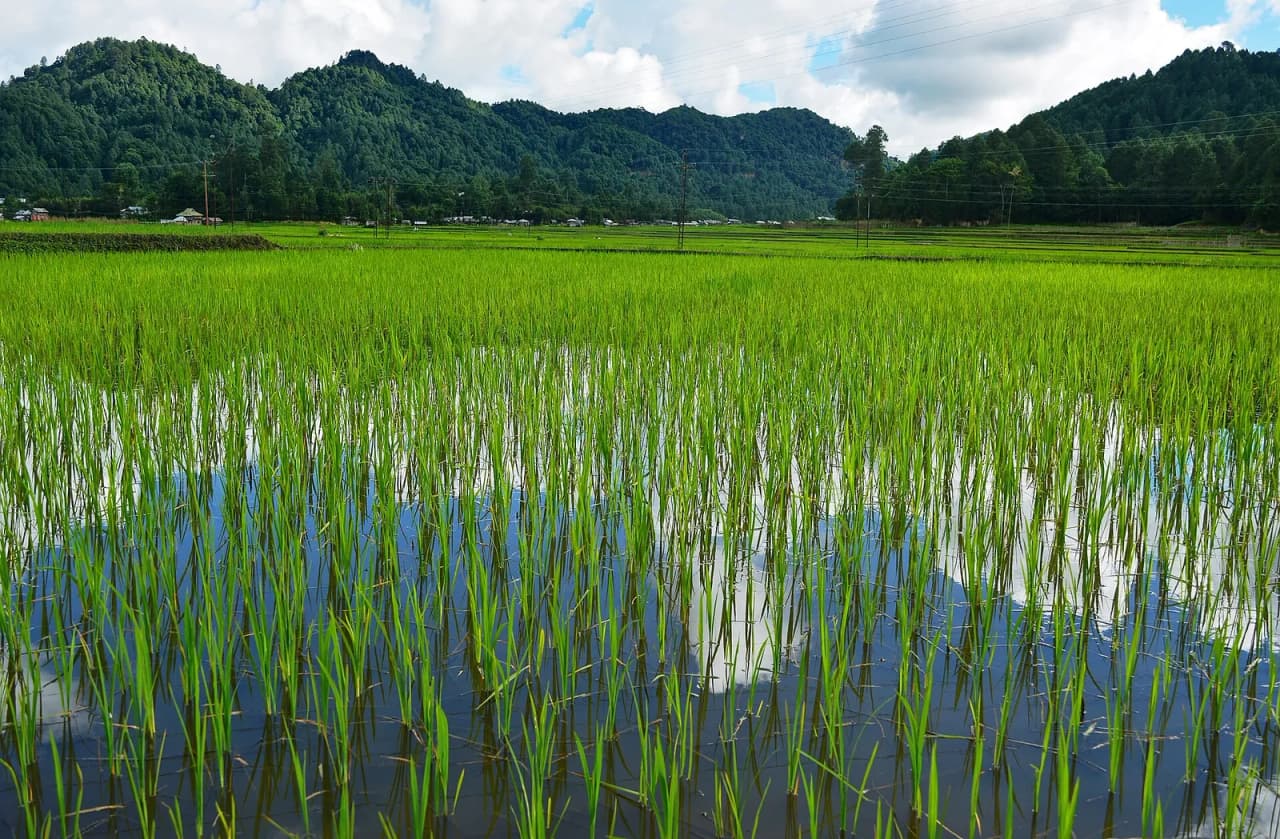
In Ziro Valley, in Arunachal Pradesh's Lower Subansiri district, the paddy fields hold two harvests. One is rice. The other swims underneath it.
For generations, the Apatani people have raised carp in the same flooded terraces where they grow rice. They call the system Aji-Nii. According to India Water Portal, which reported on a recent study of the valley, nearly 80 per cent of the farmers keeping the tradition alive are women. It is the kind of detail that is easy to read past. It should not be. In a region where land, labour and ritual are often discussed through men, a high-altitude valley has quietly run one of India's most efficient farming systems largely on women's knowledge.
A bowl of fields in the hills
Ziro sits at about 1,525 metres. The UNESCO tentative-list entry for the "Apatani Cultural Landscape", submitted by India in 2014, describes a valley "topographically cut off" from the surrounding region, with about 32 square kilometres of cultivable land inside a plateau of 1,058 square kilometres. The Apatanis, it says, have "a distinct civilization with systematic land use practices and rich traditional ecological knowledge".
Their farm is a small piece of engineering. Streams from the hills are diverted through channels. Down to Earth, in a 2023 article by researchers Rajashree Saikia and Dipankar Debnath, describes bamboo pipes that spread water from earthen channels, with one outlet set high to hold the water level and another at the bottom to drain the field at harvest. Fish are protected by bamboo fencing at the pipes. Small trenches inside each plot give them somewhere to shelter when the water drops.
The rice is local. India Water Portal names the varieties Emo, Mipya and Pyaping; Down to Earth spells them Emeo, Pyape and Mypia. The fish are mostly common carp. Finger millet is grown on the earthen bunds that divide the plots. The UNESCO entry says the nutrient washed down from the hill slopes, plus recycled crop residue and village organic waste, keeps the soil fertile year after year.
No tractors are part of this picture. Down to Earth notes that power tillers and tractors are unaffordable and hard to reach for these farmers, who mostly work with a dao (sickle) and dibbling sticks. The UNDP, in a feature on the valley, says the system needs no draught animals or machines and "solely relies on strong cooperative, communal effort".
The numbers behind the quiet
The results are modest in appearance but remarkable in context. Down to Earth reports yields of 300 to 500 kg of fish and 3,000 to 4,000 kg of rice per hectare in a season. It says the fish raise rice yields by 10 to 15 per cent by keeping down algae, weeds and insects and by adding nutrients. India Water Portal, drawing on the Ayan Samaddar study, reports 350 to 500 kg of fish per hectare per season, with no chemical fertiliser or pesticide, and says farmers in Ziro-I and Ziro-II blocks still practise some form of rice-fish farming (73 per cent and 82 per cent respectively).
The same study, as summarised there, found that fish consumption in Ziro is 10 to 12 kg per person a year, above the state average. In a place where meat and poultry can be seasonal or culturally restricted, that matters for nutrition, especially for children and women, according to the report.
One small human detail comes from the Telegraph's 2015 report from the valley. A farmer from Hija village, Taku Lodor, told the paper he had grown 40 quintals of paddy and 50 kg of fish that season. It is a single household's figure, nothing more. But it shows what the research averages mean at the scale of one family.
Whose work is it?
The most striking claim is about who does the work. India Water Portal reports that in Ziro-II almost 46 per cent of fish farmers were women. They take part in stocking, feeding, harvesting and even building ponds, the report says, and researchers observed better record-keeping, fairer household nutrition and a stronger focus on sustainability where women were involved. Women's self-help groups have begun collective fish farming, sharing labour, costs and harvests.
A research paper, "The Art of 'Organic' Living: Lessons from Apatani Women", hosted in the AIRS archive, goes further into the seasonal calendar. It describes work organised by farmer groups, several of them led by a woman. In its account, the bunds are repaired in late January around the Murung festival by a group led by a woman called the lenda-kagenee. Women of another group build and mend fences after the farming season. In February, seedlings are raised in nurseries from seed that women have stored from the previous harvest; the paper calls them "expert seed collectors". Rice transplanting begins in April, and the first fingerlings go into the fish pits.
The same paper is honest about the limits. Even as it praises these women's knowledge, it says that "like other patriarchal milieus" they are excluded from decision-making. That is the author's finding, and it is worth keeping next to the praise. Doing the work and holding the power are not the same thing.
A calendar of festivals
Farming here is also a calendar of thanks. Down to Earth lists the main Apatani festivals as Myoko, Dree, Yapung and Murung, which people believe bring better productivity and well-being. The Telegraph's 2015 visit found the Myoko celebration, which it describes as a festival of brotherhood, under way in Hong village.
Dree is the largest. India Today NE reported this July that the Apatani community celebrated it on 5 July, with the largest gatherings in Ziro Valley and Itanagar, to seek blessings for the harvest and timely monsoon and protection from drought and famine. Amar Chitra Katha's account says that for most of history each village marked Dree separately, until Apatani students in 1967 decided the community needed one festival everybody could share, with 5 July as the main day. It also describes the Daminda, a song and dance performed by women in long linked lines, whose verses recount the people's history and geography.
What could break it
The system is not frozen, and it is not safe. The UNDP feature warns that climate change and urbanisation have lured farmers from the valley, leaving some paddy fields abandoned and lowering rice production. Its answer included fish hatcheries for year-round harvests, community seed banks for traditional varieties and agroforestry along the existing irrigation. India Water Portal lists other problems from the study: fingerlings brought from Assam or Meghalaya, which raise costs and cause deaths; limited technical training; water scarcity as the monsoon shifts; and poor cold storage and transport, which push farmers to sell locally at low prices. It also notes that hill-stream irrigation is under stress from deforestation and unplanned road building.
Worry about the landscape itself is not new. In the Telegraph's 2015 report, the Lower Subansiri administration banned unplanned construction, including filling up paddy fields, saying it would threaten the unique culture and the chance of World Heritage status. The paper also reported a ban on plastic bags and bottles, because plastic was clogging the natural channels that feed the fields. A 70-year-old villager said at the time: "We need the World Heritage Site status." Tapi Tai, general secretary of the Apatani council Tanii Supun Dukun, was quoted as saying: "Our agriculture practice is not just a tradition but also a source of livelihood for most of us."
Status is a tricky thing. The UNESCO entry has been on India's tentative list since 2014, but a tentative listing is not a World Heritage inscription. We found no source confirming that a full nomination has been submitted. Some sources also describe the valley as recognised under the FAO's Globally Important Agricultural Heritage Systems programme; others say it has only been identified as a potential site. We could not settle this from the public record and do not rely on the claim.
Why this matters for the North East
Across the hills of the region, farming policy still tends to treat shifting cultivation as the problem and the plains as the model. Ziro offers a third picture: a settled, low-input, mountain system that feeds people, protects water and gives women a visible place in the work. The UNDP says the valley has been identified as a potential "other effective area-based conservation measure", a national recognition for places where people and biodiversity do well together.
The practical lessons are plain. The study's authors call for stronger hatcheries and seed banks inside Arunachal, training through Krishi Vigyan Kendras, and credit for women's self-help groups. None of that needs the valley to change what it is. It needs the people already doing the work to be paid, trained and listened to.
No outsider can hurry an Apatani paddy. Rice goes in during April and comes out in September and October, with fish harvested twice in between, according to Down to Earth. In the end, the valley's best idea is also its simplest. The same water can feed more than one thing, if enough people agree to look after it together.
Each year the same cycle returns: bunds mended in January, seedlings in February, fingerlings in April. Whether the next generation will take up the dibbling stick is a question no study can answer for them.
Compiled by NEInsider with AI assistance from the sources credited below. How we use AI
Sources and credits. With inputs from India Water Portal (https://www.indiawaterportal.org/agriculture/fish-fields-and-feminism-how-apatani-women-sustain-ziros-aquaculture-in-arunachal-pradesh), Down To Earth (https://www.downtoearth.org.in/agriculture/towards-sustainability-arunachal-s-apatanis-use-a-unique-integrated-cultivation-method-it-needs-encouragement-87688), UNESCO World Heritage Centre tentative list (https://whc.unesco.org/en/tentativelists/5893/), The Telegraph India (https://www.telegraphindia.com/north-east/apatanis-await-heritage-tag/cid/1529371), UNDP India (https://www.undp.org/india/stories/bio-cultural-treasure), AIRS research paper (https://airs.org.in/wp-content/uploads/2024/09/The-Art-of-%E2%80%98Organic-Living-Lessons-from-Apatani-Women.pdf), India Today NE (https://www.indiatodayne.in/arunachal-pradesh/video/apatani-community-celebrates-dree-festival-across-arunachal-with-traditional-fervour-1419205-2026-07-05), Amar Chitra Katha (https://www.amarchitrakatha.com/history_details/the-dree-festival-harvests-of-the-apatani-tribe/). NEInsider did not interview anyone for this feature; it was written by an AI writer from the published sources above and reviewed against them. Quotes are credited to where they were published.
Share this story
Forward it to your family WhatsApp group. News from home travels fastest there.
Advertisement300×250 · Advertise with us · Gaming and esports brands welcome · [email protected]