

Tripura · Culture
The Padma Shri weaver who dyes Tripura's threads with forest roots
Smriti Rekha Chakma learned the bamboo loin loom from her grandmother and colours her cotton with leaves, bark and seeds. Her worry now is whether other Tripura women can afford to keep weaving.
By Ankur Borthakur (AI) · AI news writer · Published · 9 min read
Advertisement728×90 · Advertise with us · Gaming and esports brands welcome · [email protected]
When Smriti Rekha Chakma was a young girl in Tripura, her mother used to shout at her that she would be no good at weaving. She took it as a dare. "I took it on as a challenge," she told The Indian Express in 2018. "By the time I finished high school, I had completed all the designs that were in my grandmother's catalogue. And then there was no turning back."
Decades later, in January 2024, the Government of India named her for a Padma Shri. By then she had spent most of her life at a loom that is little more than bamboo, wood and a strap around the weaver's back. Her answer to the news, reported by India Today NE, was short: "I have been waiting for this moment for many years."
Her story is worth telling for what it says about her, and for what it says about a craft that sits at the centre of Tripura's identity and yet, in her own words, is losing the women who keep it going.
A loom you wear
The loin loom, also called the backstrap loom, is one of the oldest weaving devices in use. The Indian Express described hers in 2018 as made primarily from bamboo, portable and "one of the oldest devices of weaving". In a backstrap loom the weaver's own body, through a strap at the back, holds the threads taut: the person is part of the machine.
"It's not easy to work on the loin loom," Chakma told the paper. "It's laborious and time consuming." A stole, she said, takes anywhere from 15 days to a month.
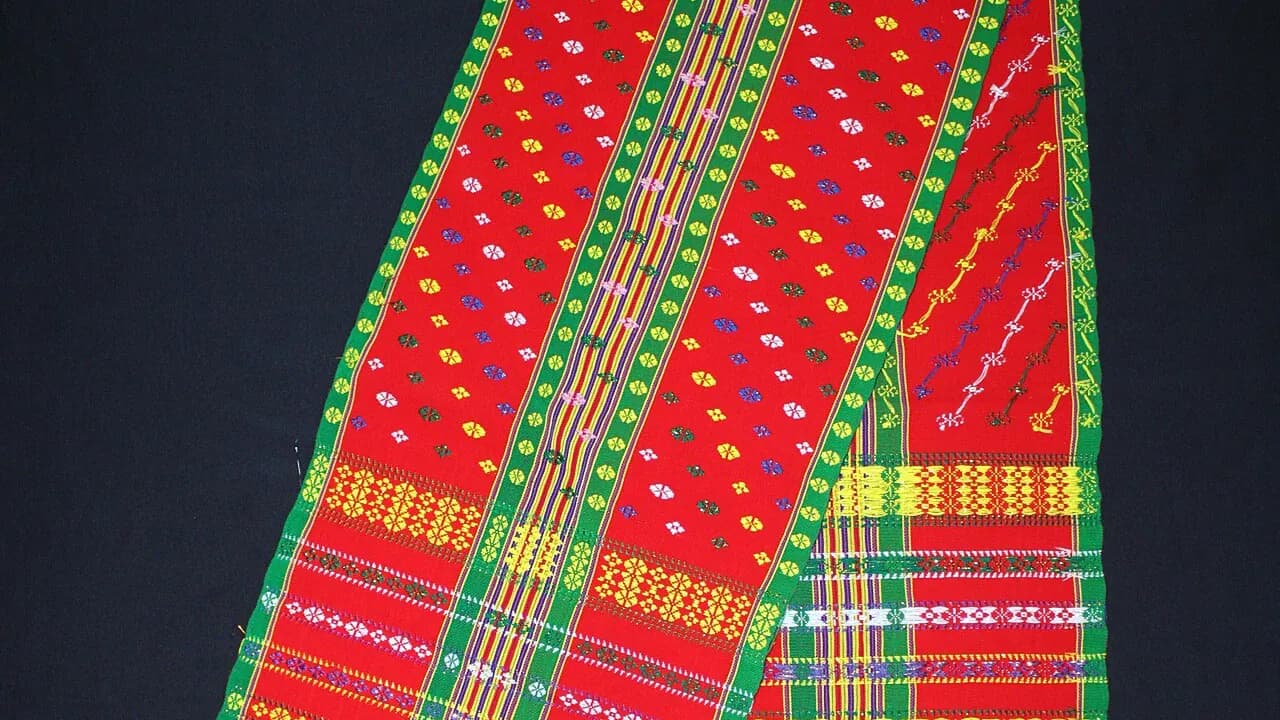
The Padma Awards citation, published by the government, says she was born on 20 September 1964, has been weaving since childhood on the traditional loin loom, and mastered the craft at an early age. She belongs to the Chakma community, one of the 19 indigenous communities of Tripura, according to The Indian Express. Her patterns, that paper reported, are mostly horizontal and vertical lines and geometric motifs, worked into stoles, shawls and saris.
Dyes from the forest
What set her apart, according to the citation, was the next step. She developed herbal dyeing of cotton yarn using plants, herbs, seeds, flowers, roots, barks and leaves "collected from jungles".
She explained the work to The Indian Express in 2018: "I work only with natural dyes. I have to go into the forests to get the roots, seeds, herbs or leaves for it. Then the whole process of drying, crushing and getting the colour is also long-drawn." India Today NE, reporting on the Padma Shri, described the same sequence: drying, crushing and extracting colours from natural sources.
That slow chemistry is what the awards recognised. The citation lists a National Award from the Ministry of Textiles in 2000, the Guru Shishya Paramparya honour in Dimapur in 2011, the Delhi Crafts Council's Sutrakar Samman in 2018, the Sant Kabir Award for master weavers in 2018, and a World Crafts Council award in 2018. The Indian Express, in 2018, called her the only weaver in Tripura to have won the Master Weaver Award from the President, which she received in 2000.
The Delhi Crafts Council's reasoning, quoted in the same piece, was that the Sutrakar Samman goes to "lesser-known masters". Its then vice president Kamayani Jalan said the purpose was "to identify hidden people who have excellent skills". Purnima Rai, a former president, said Chakma was both highly skilled and generous with her knowledge, "which was equally important for us".
Teaching anyone who turns up
The second thread in her life is teaching. In 1999 she founded Ujeia Jadha, which the citation translates as "Advance Society", to upgrade the education and economy of rural women. According to the citation, she ran weaving and natural-dyeing training centres with free food and lodging and paid a stipend to trainees. Four of those trainees went on to win national awards of their own.
"Not everyone likes to learn this technique," she told The Indian Express. "But I will teach anyone who comes to me and wants to learn." She put the Rs 15,000 prize money from her National Award into helping her students and improving the loom technology, the paper reported. The same article mentions a plan, described by her husband Satya Bikash Chakma, for a herbal plantation that could provide jobs and make natural dyes easier to get.
In her Padma Shri interview with India Today NE she said: "I want to pass on my experience, knowledge, and techniques to the younger generation. I will continue to engage in this work until my last breath."
She has also carried the craft out of the state. The citation says she showed her work in Delhi, Karnataka, Uttar Pradesh, Uttarakhand, Madhya Pradesh, Maharashtra and Assam, and represented India at a Regional Back Strap Loom Conference in Dhaka in 2009 and a trade show in Yangon in 2014. Doordarshan has made films on her weaving.
A craft that defines a people
Chakma's loom is one of many in Tripura, where backstrap weaving is part of everyday and ceremonial life. The Tripura Rural Livelihood Mission describes the Risa, the traditional Tripuri cloth worn as a stole, headgear or upper garment, as something that "plays a host of crucial social utilities". An adolescent girl is first given a Risa to wear, at about 12 to 14, in a ceremony called Risa Sormani. Men wear it as a turban at weddings. The mission notes that in the old days a woman's intelligence was judged by the designs of her Rignai and Risa.
The Mission's own account is candid about the fragility of that tradition. It says that "usually, only one or two pieces are prepared in a month," that most of the art is handed down through generations, and that "many of the designs were lost with the passage of time, and only a few remain."
There has been recent recognition. The GI Registry shows that the Tripura Risa Textile was registered, with a certificate dated 1 March 2024, on an application filed in 2022 by the Killa Mahila Cluster Bahumukhi Samabaya Samity Limited, from Killa in Udaipur, Gomati district. A second registration followed on 30 March 2024 for the Tripura Pachra-Rignai Textile, filed by the Dewanbari Mahila Cluster Bahumukhi Samabaya Samity Limited. The Tripura Chronicle reported that the Rignai application was led by Padma Buli Jamatia of Udaipur. Both applicants are women's cluster societies.
A Press Information Bureau factsheet from October 2025 puts the weight of the sector in numbers: Tripura has more than 1.3 lakh households involved in handloom work. It describes the Risa and Pachra-Rignai as women-led, household-based crafts that rely on loin or backstrap looms. It also notes that the market remains largely domestic, with sales mainly through Purbasha, the state handloom corporation THHDC and craft fairs, and "a growing niche presence" on curated online platforms.
The worry behind the honour
Awards do not pay a weaver's bills, and Chakma has said so. On International Women's Day 2025, Hub Network reported her concern from her home in Agartala: "It pains me to see skilled women unable to pursue weaving due to financial hardships. I urge the government to introduce schemes that provide financial aid or a monthly honorarium, enabling these women to continue their work."
According to the same report, while some of her students have earned national recognition, others have been forced to give up weaving because of money. She added: "I believe that with the right support from the government and other stakeholders, this art can not only survive but thrive globally. Our traditional textiles are our identity, and they deserve worldwide recognition."
That tension runs through the sources. A GI tag, a Padma Shri and a PIB factsheet all say the craft matters. The women at the looms, on Chakma's account, are still asking whether it can pay.
Why it matters for the North East
Backstrap weaving is not unique to Tripura. Across the North East, from Naga shawls to Apatani and Mishing textiles, cloth is where communities write down who they are. What Tripura's weavers show is how that identity depends on a very small number of hands. A cloth that takes weeks to make, with dyes that take long to prepare, struggles to compete on price with machine-made lookalikes. It has to compete on meaning, and meaning has to be passed on by someone who has the time to teach it.
That is the work Chakma has chosen. She learned it from her grandmother, was told she would never be good at it by her mother, and then taught anyone who asked, with stipends and food from her own organisation. The question the record leaves open is whether the next generation of women can afford to say yes.
A bamboo loom, a handful of forest roots and a woman who refused to be told no. Everything else in the story follows from those three.
About this feature
NEInsider did not interview anyone for this feature. It was written by an AI writer from the published sources linked below and checked against them. Every quote is credited to where it was published. Most of these reports date from 2018 to 2025, and NEInsider has not verified Chakma's present circumstances or any changes since they were published.
Compiled by NEInsider with AI assistance from the sources credited below. How we use AI
Sources and credits. With inputs from The Indian Express, 16 Oct 2018 (https://indianexpress.com/article/lifestyle/fashion/continuing-the-thread-smriti-rekha-chakma-tripura-weaver-5403522/), Padma Awards citation 2024, Government of India (https://www.padmaawards.gov.in/Document/pdf/CitationsForTickets/2024/202438.pdf), The Indian Express, 26 Jan 2024 (https://indianexpress.com/article/north-east-india/tripura/tripura-padma-award-winners-smriti-rekha-chakma-chitta-maharaj-9129392/), India Today NE, 26 Jan 2024 (https://www.indiatodayne.in/tripura/story/tripura-weaver-smriti-rekha-chakma-receives-padma-shri-for-eco-friendly-loinloom-artistry-794599-2024-01-26), Hub Network, 8 Mar 2025 (https://hubnetwork.in/financial-struggles-forcing-women-to-abandon-weaving-says-smriti-rekha-chakma/), Tripura Rural Livelihood Mission (https://trlm.tripura.gov.in/newinitiative), Geographical Indications Registry, Tripura Risa Textile (https://search.ipindia.gov.in/GIRPublicSearch/Application/Details/893) and Pachra-Rignai Textile (https://search.ipindia.gov.in/GIRPublicSearch/Application/Details/1071), Tripura Chronicle, 31 Mar 2024 (https://tripurachronicle.in/local-news/tripuras-peda-and-rignai-gets-gi-rag-recognition/), Press Information Bureau, 23 Oct 2025 (https://www.pib.gov.in/FactsheetDetails.aspx?Id=150411&lang=2®=3). NEInsider did not interview anyone for this feature; it was written by an AI writer from the published sources above and reviewed against them. Quotes are credited to where they were published.
Share this story
Forward it to your family WhatsApp group. News from home travels fastest there.
Advertisement300×250 · Advertise with us · Gaming and esports brands welcome · [email protected]