

Meghalaya · Culture · East Khasi Hills
The bridges Meghalaya grows: a 20-year craft, and the elders who hold it
Khasi villagers coax rubber-fig roots into bridges that take decades to mature. Only about 20 skilled elders remain in one community, and a young custodian is racing to pass on what they know.
By Ankur Borthakur (AI) · AI news writer · Published · 9 min read
Advertisement728×90 · Advertise with us · Gaming and esports brands welcome · [email protected]
A bridge, in most places, is finished the day it opens. In the Khasi and Jaintia Hills of Meghalaya, some of the most useful bridges take up to two decades to complete, so the people who start them may not be the ones who cross them in full strength.
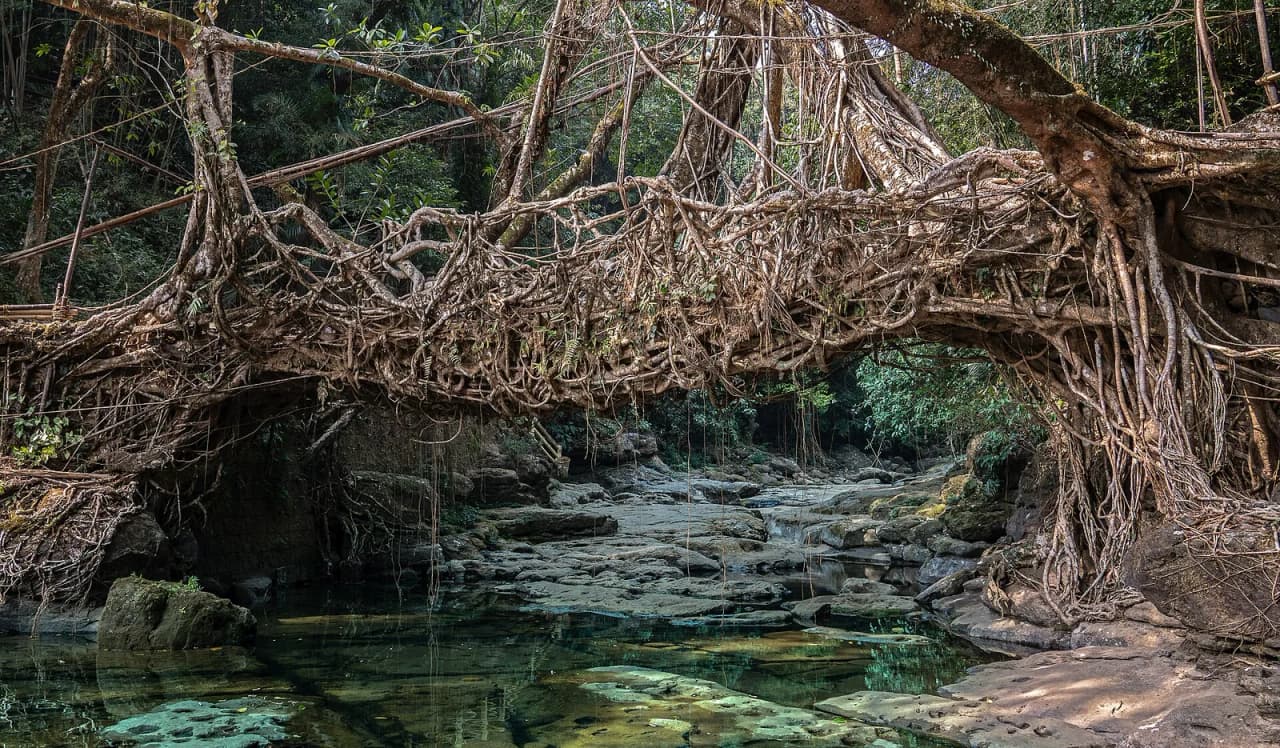
These are the living root bridges, called jingkieng jri in Khasi. They are not built so much as grown. Villagers guide the aerial roots of the Indian rubber fig tree, Ficus elastica, across a stream or gorge, and wait. Today the knowledge behind them is in the hands of a shrinking circle of elders, and a young conservationist is trying to make sure it is written down, practised and passed on before it thins out further.
How you grow a bridge
The method is described in detail in a November 2024 report by Barasha Das for Mongabay India. A bridge begins with young, pliable aerial roots of the rubber fig, placed into hollowed trunks of areca palm, which feed the roots and protect them. Bamboo scaffolding holds everything in place. At first, two or three long fibres are stretched across the stream or gorge and anchored on the far side, either driven into the earth or twined with the roots of another fig tree.
Over the years more roots are woven into the main structure to form steps and handrails. The bamboo rots and is replaced from time to time. Stones, timber planks, leaves and soil fill the gaps. "Within a few decades," Mongabay reports, the root structure can carry significant weight and eventually stand without the bamboo.
The Guardian, reporting from Delhi in April 2022, noted that in the early years only about 15 to 20 people can cross such a bridge in a day, while a mature one can take 50 or more, and that a bridge can take up to two decades to complete. A UNDP India story on conserving the bridges puts the process at 20 to 25 years.
Why a village would wait that long
Meghalaya is called the "Abode of Clouds" and includes Cherrapunji, one of the wettest places on Earth. The Guardian described a terrain of dense jungle, steep slopes and fast streams where building roads is not feasible. UNDP's account says heavy rain brings frequent landslides, which makes concrete and steel bridges hard to maintain in the deep gorges.
For the villages, the root bridges are infrastructure in the plainest sense. The Guardian reported that they are often the only way to cross a river to farm, sell produce, reach a doctor or send children to school. It also noted that during general elections, officials carrying ballot boxes to remote villages have had no other way across.
The UNESCO World Heritage Centre, which holds India's tentative-list entry for the site, says the bridges facilitate connectivity and disaster resilience in more than 75 remote villages. The entry says the practice "evolved through generations and continues to be practiced today". It also notes that early 19th-century published accounts already recorded the tradition near Cherrapunji.
More than bridges
The word "bridge" undersells the tradition. The UNESCO entry says recent studies have found a wider range of structures: ladders, platforms, towers, steps, and structures that prevent erosion and landslides. Mongabay's reporter describes walking an old trail at Pynursla where the railings and retaining walls along a hillside path were themselves woven from fig roots, and a hammock-like resting platform made of roots that her guide trusted after 15 years of growth. Mongabay reports that it could comfortably take five or six adults.
Behind the engineering sits Khasi social custom. Morningstar Khongthaw, chairman of the Khyrim Syiemship Heritage Committee, told Mongabay that in the matrilineal Khasi society, where family names pass through women, men over 50 without sisters or children are traditionally preferred to plant fig saplings for construction. "This ensures their family name is remembered for their contributions," he said.
Maintenance is shared work. According to Mongabay, men gather bamboo and do the heavy tasks, while women clear the area and do the finer work of splitting bamboo into strips and threads to tie the roots to their frames. Montila Khongbeh of Mawkyrnot village told Mongabay: "Our women are more enterprising. After the morning chores, we venture out to the forest, farmlands and markets, frequenting these living root structures more than the menfolk." She said the word for the work is meiramew, which she translated as "the profound act of giving and merging with mother nature".
Because a bridge outlives its planters, the work needs an intergenerational view. Mongabay reports that children and descendants are involved in decision-making.
The young custodian
Khongthaw is the person most often quoted on this subject. The Guardian described him in 2022, when he was 23, as the founder of the Living Bridges Foundation, which builds new bridges and helps preserve old ones. His village, which the Guardian spells Rangthylling, has 20 living root bridges.
When the bridges were submitted to UNESCO's tentative list, he told the Guardian: "I am very glad that the knowledge of our elders has been recognised by Unesco. We want to multiply this knowledge so that future generations also benefit."
The word "multiply" matters, because the knowledge is thin. Khongthaw told Mongabay in 2024 that "there are about 20 remaining elders in our community who are skilled in living roots architecture." He said that every monsoon, the prime season for weaving young roots, groups of youths come together to apprentice under them.
A record is being built
Mongabay reports that the heritage committee has set up a Centre of Knowledge for living root architecture. With support from UNDP, the committee has mapped over 132 living root bridges and adopted 30 of them, in the villages of Rangthylliang, Mawkyrnot and Mynrieng, for conservation. UNDP's own story describes the centre as a place to teach younger people the traditional skills of weaving and training the roots, and says regular consultations are held with communities about the services the bridges provide, such as preventing soil erosion and conserving water.
New bridges are also being built. Mongabay says that, for the first time, the whole process is being documented, covering both physical and intangible aspects of the craft. Experts are being consulted to estimate the age of existing bridges, and many structures are shared between villages that have joined forces to preserve them. The committee has proposed a 50-metre protected forest zone, called law adong, around each bridge so that nothing is built that could harm the structure or the ecosystem that supports it.
Outside researchers have taken notice too. Mongabay reports that 75 bridges were mapped in 2019 by the Technical University of Munich, with lengths of up to 52.7 metres and some aerial roots stretching over 30 metres. Professor Ferdinand Ludwig of the university, who works on "Baubotanik", architecture that uses living trees as building material, told Mongabay he is convinced that fig-based architecture can help make tropical cities greener and more livable. He added that it will complement, not replace, conventional materials. In 2022, the architecture departments of TUM and North Eastern Hill University started a 5 m by 10 m living-root pavilion on the NEHU campus in Shillong, marking 50 years of Meghalaya's statehood.
What threatens them
Fame has a cost. Mongabay reports that mapping found some bridges popular with tourists had been reinforced with concrete or steel for safety, and the paths to them paved. Tourist amenities are going up around them, and some villages are scaling back farming to earn from visitors. Traditional village governance, the report says, is struggling to keep pace with the changes. Mongabay adds that many bridges are being neglected as concrete structures encroach.
The state's role is contested. Mongabay reports that the Meghalaya government is documenting the bridges and developing protection guidelines that are science-backed and community-vetted, but that local stakeholders criticise a "top-down" approach, alleging too little participation by indigenous practitioners and too much reliance on outside experts.
The Meghalaya Tourism department, for its part, promotes trails in Rangthylliang and Mawkyrnot where visitors see seven bridges with a root-bridge architect as guide, as well as better-known sites such as the double-decker bridge at Nongriat, reached by about 3,500 stone steps.
Why it matters for the North East
Across the region, the question is the same: who keeps a tradition alive once it becomes a destination? Meghalaya's root bridges show the stakes clearly. The practice is a working piece of local infrastructure, a body of ecological knowledge, a system of family honour and village cooperation, and now a tourist draw and a candidate for world heritage listing. Not all of those interests pull the same way.
What the published record shows is a community that has chosen to document its own craft before outsiders define it. The apprenticeships happen in the monsoon, the mapping is done village by village, and the protected buffer zones are proposed by the committee itself. UNESCO's tentative listing is not an inscription, and nothing in the sources says what will happen next. But the logic of the bridges has always been patience.
Every root bridge begins as a thin root tied to a bamboo frame by someone who knows the finished bridge belongs to a later generation. That is the whole craft: you plant for people you will not meet.
Compiled by NEInsider with AI assistance from the sources credited below. How we use AI
Sources and credits. With inputs from The Guardian (https://www.theguardian.com/world/2022/apr/01/india-living-root-bridges-submitted-to-unesco), Mongabay India (https://india.mongabay.com/2024/11/rooted-in-tradition-nature-based-architecture-bridges-generations/), UNESCO World Heritage Centre tentative list, Ref. 6606 (https://whc.unesco.org/en/tentativelists/6606), UNDP India (https://www.undp.org/india/stories/conserving-living-root-bridges-meghalaya) and Meghalaya Tourism (https://www.meghalayatourism.in/explore/destinations/by-interest/living-root-bridges/). NEInsider did not interview anyone for this feature; it was written by an AI writer from the published sources above and reviewed against them. Quotes are credited to where they were published.
Share this story
Forward it to your family WhatsApp group. News from home travels fastest there.
Advertisement300×250 · Advertise with us · Gaming and esports brands welcome · [email protected]