

Manipur · Culture · Ukhrul
Longpi's black pots: a Manipur craft with no wheel, now in Delhi
Ground serpentine stone, hill clay and a bonfire: how a Tangkhul Naga village's cooking pots reached a Padma Shri and Delhi design studios.
By Ankur Borthakur (AI) · AI news writer · Published · 10 min read
Advertisement728×90 · Advertise with us · Gaming and esports brands welcome · [email protected]
In Longpi Kajui, a Tangkhul Naga village in Manipur's Ukhrul district, the first ingredient of a cooking pot is a rock. It is dark, heavy and flecked with green, and it has to be broken and ground to powder before anything else can happen. Only then does it meet the brown clay of the hills, a splash of water and a pair of hands that know, without a wheel, how to turn the mixture into a vessel.
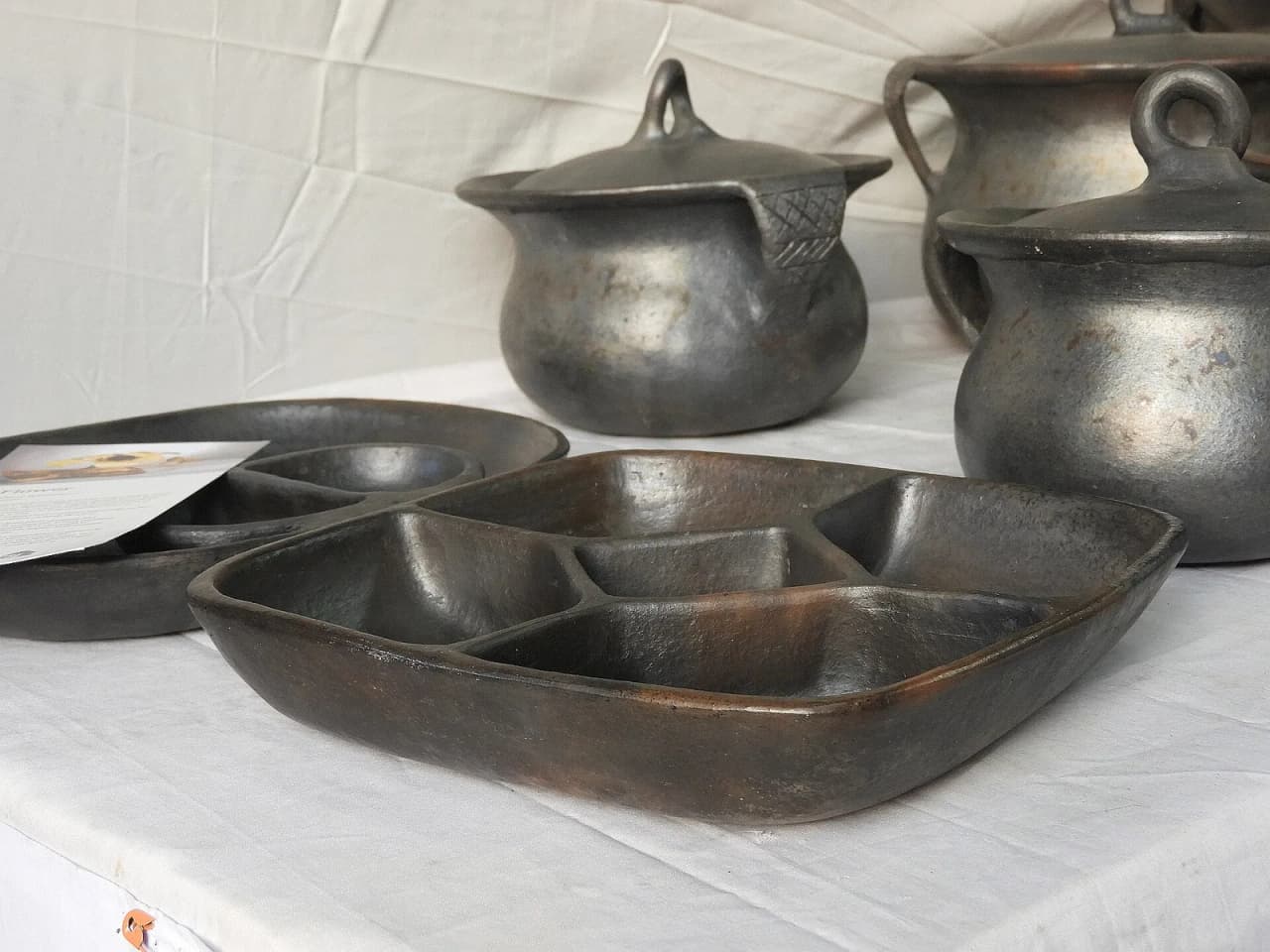
The result is Longpi pottery, also called Nungbi pottery or, in Tangkhul, hampai. It is gunmetal black, gleams like polished stone, and was for generations the cooking pot of the hills. Today it sits in Delhi design studios, and its best-known master, by his son's account, could not read when his work first reached a government exhibition.
A pot with no wheel
The method is what sets it apart. Potters mix powdered serpentinite, a black stone found in the hills around Longpi, with a local brown clay. According to a report by the Indira Gandhi Rashtriya Manav Sangrahalaya (IGRMS) museum in Bhopal, carried by the Free Press Journal, the clay is known locally as salai nali and the stone as lishon-loong, and the two are blended in a ratio of 2:3.
There is no potter's wheel anywhere. A paper on Longpi pottery moulding in the International Journal of Scientific Development and Research describes a long list of bamboo and wooden tools, each named in the Tangkhul language and each used for a specific stage, from shaping the upper part of a pot to finishing its base. The paste must be kept free of impurities, the paper adds, because they can make a pot burst in the fire.
The firing is done in an open bonfire. A feature published by the Isha Foundation says the pots are heated for five to seven hours and scrubbed, still hot, with the leaves of a local plant called machee. That is what produces the dark, glossy surface. The Hindustan Times, in a March 2025 feature, describes the same finish: "The fired items are then rubbed with a local leaf, which makes the ebony surface gleam."
The cooks swear by it. India Today NE says Longpi pots are known for enhancing the taste of food, and the PTI report notes a general belief that meat in particular tastes better cooked in this black earthenware. We have not tested the claim, but it has clearly helped demand.
From barter to the Padma Shri
Pottery here is old. The Padma Awards citation for the craftsman Machihan Sasa describes Longpi Kajui as "the oldest Tangkhul Naga Village known to have been practicing Longpi Hampai art since 10,000 BC", a Neolithic date that other outlets repeat. The IGRMS report says Longpi potters used to exchange their earthenware for meat, rice and baskets. The IJSDR paper says pots from the area were once the main cooking and storage vessels for neighbouring Naga groups before aluminium and steel arrived.
That arrival is what put the craft at risk. Cheap metal pots do not break and do not need a special clay. The Hindustan Times puts the danger bluntly: Longpi pottery "would have remained a niche craft, fading out of existence, had one craftsman not taken a leap of faith."
That craftsman is Machihan Sasa. The official Padma citation says he was born in 1950 in Longpi Kajui and learned the craft from his father at an early age. Formal schooling was out of reach because of the family's finances and the lack of schools nearby. The same document says he began to widen the range of the craft, adding tea sets, flower pots, vases, kettles, bowls, water mugs, dining plates, casseroles and kadais to the traditional pot.
His breakthrough came through exhibitions. He first showed work at the All India Handicrafts Week in Ukhrul in 1979, according to the citation, which lists that as his first prize. The Hindustan Times gives a different, more human version. It quotes his son Mathew Sasa saying that Machihan carried his wares to a local market in 1978 and caught the eye of government officials. "My father was not literate at the time," Mathew says. "The officials helped him attend exhibitions at the Delhi Crafts Museum." The accounts differ by a year; we report both as published.
The honours followed: a State Award in 1986, a National Award in 1988 and the Shilp Guru title in 2008, then a Padma Shri for art in January 2024. EastMojo reported that locals call him Awo, the Tangkhul word for grandfather.
"My greatest regret"
The interview that tells most about the life behind the award was published by The Sangai Express, from a PTI report by Mungchan Zimik in Ukhrul. Sasa spoke through his personal secretary, and the words quoted in that report are plain.
"I have trained some 70 youths of which four/five have received State-level awards," he said. "However, my greatest regret is not being able to teach more due to the economic hardship."
Other outlets say more than 300 (EastMojo, India Today NE, Hindustan Times); the Padma citation says three trainees have won National Awards and three State Awards. We cannot reconcile 70 with 300 from public material alone, so we give both. What every source agrees on is the direction: the craft's survival depends on teaching the young.
The same interview gives an unusually honest account of the economics. In earlier days the special clay was taken freely from a place called Salah at Nungbi Khullen village. These days, Sasa said, "with rising demands and commercialisation, the clay has to be purchased at Rs 700 per tin." Collecting it in the rainy season is "a risky task". Income depends on orders: in a good season he might earn around Rs 75,000, "however, the income during the rainy season would be none".
His wish, as quoted by PTI, is to train unemployed youth "with a full set of infrastructure" and to open a museum at his home "so that the legacy of black pottery can be passed down".
The women who joined in
Longpi pottery was traditionally men's work. The IGRMS report says that "the making of pots by women was considered a social taboo", and that women have gradually started making pottery because it is the major source of the local economy. The IJSDR paper, which studied two Longpi villages, found that in Longpi Kajui both men and women now practise the craft, while in Lori Seiri only men do.
The Isha Foundation feature profiles one such woman, Presley Ngasainao, who learned the craft from her grandfather. According to that piece, she and 16 other women formed the Loree Hamlei village pottery collective to make and market Longpi pottery. The article says their cookware is now sold to craft stores across India and abroad. The Isha piece promotes a handicrafts fair, so its sales claims deserve some caution. The 30 Stades culture site adds that male potters still outnumber women.
A kettle that looks Dutch
The most unexpected chapter is in Delhi. Machihan's youngest son, Mathew Sasa, told the Hindustan Times about an order in 2001: 500 pieces for Belgian buyers. The family felt it was too large to move from Manipur to Delhi, so Mathew said they carried the clay and tools by train, borrowed space from a friend, and made the pottery there. "It was the first time the craft was being made outside of their hometown," the report says. It prompted him to set up a studio in the capital, where he now works with design brands on new cookware, tableware and decorative pieces.
The Hindustan Times says that "at first glance, it looks like something out of a Dutch design studio": a kettle with a doughnut-like body, a jug shaped like hollow bamboo, a coaster that doubles as a jigsaw puzzle. Mathew says he has trained close to 40 young people from home in Delhi, because "many youngsters back home have few job opportunities". He also says that "more youngsters are interested in learning and selling this pottery online."
That is the modern twist, but it carries a warning that he states himself: "The craft will continue until the materials, which are only found there, exist."
What is being built now
Several institutional moves are under way, though none is complete. In its March 2025 report, the Hindustan Times said a government-supported artisan village was scheduled to open in Longpi, with three years of stipends and visits from design experts, and an intention that locals would eventually form a cooperative. We could not find a public record confirming that the village has opened.
A formal step is on record, though. The Intellectual Property India registry shows that an application for a Geographical Indication tag for "Manipur Longpi Pottery" was filed on 3 April 2025 by the Sasa Hampai Pottery Training Cum Production Cooperative Society Limited, based in Longpi Kajui. The registry lists its status as "Examination", with an examination report dated 6 July 2026. It is not yet registered. A GI tag would not protect the clay or the hands, but it would give the name legal weight, which matters when a craft starts to travel.
Why it matters for the North East
Longpi's story has a shape familiar across the region: an old technique, a few master keepers, a raw material that is hard to get, and a market far from the village. Here, unusually, the chain is visible in public records, from the Padma citation to the clay price to the GI file.
It also shows that survival and change are not opposites. A pot that once bought a basket of rice now appears in a Delhi design brief. Women once kept from the craft now sit among its makers. Clay once dug freely now has a price per tin.
The sources do not paint a rosy picture. The master wishes he could teach more, the clay is costlier, the rainy season brings no income, and official help is promised but not yet confirmed.
Still, in a village in Ukhrul, someone is breaking a black stone this week. It will be ground, mixed, shaped by hand, fired in the open and polished with a leaf until it shines. Whether that shine lasts another generation depends on something the old potters have always known: you cannot teach a craft to people who cannot afford to learn it.
Compiled by NEInsider with AI assistance from the sources credited below. How we use AI
Sources and credits. With inputs from Padma Awards citation for Machihan Sasa, Government of India (https://www.padmaawards.gov.in/Document/pdf/CitationsForTickets/2024/2024108.pdf), The Sangai Express/PTI (https://www.thesangaiexpress.com/Encyc/2024/1/28/Mungchan-Zimik-PTIUkhrul-Jan-27-Machi-han-Sasa-a-renowned-Tang-khul-craftsman-who-promotes-and-preserve.html), Hindustan Times (https://www.hindustantimes.com/lifestyle/brunch/change-of-art-see-how-three-unusual-indian-crafts-are-getting-a-reboot-101743108136563.html), EastMojo (https://eastmojo.com/manipur/2024/01/27/ukruls-earthen-alchemist-how-padma-shri-machihan-sasa-made-longpi-pottery-famous/), India Today NE (https://www.indiatodayne.in/manipur/story/manipur-ukhruls-machihan-sasa-conferred-padma-shri-for-longpi-pottery-expertise-794524-2024-01-26), Free Press Journal (https://www.freepressjournal.in/bhopal/manipurs-longpi-pottery-exhibited-at-indira-gandhi-rashtriya-manav-sangrahalaya-igrms-in-bhopal), IJSDR paper (https://ijsdr.org/papers/IJSDR2406092.pdf), Isha Foundation (https://isha.sadhguru.org/en/blog/article/hands-grace-manipuri-black-stone-pottery), 30 Stades (https://30stades.com/art-culture/manipurs-longpi-nungbi-black-pottery-handmade-with-stone-without-potters-wheel) and the IP India GI registry (https://search.ipindia.gov.in/GIRPublicSearch/Application/Details/1495). NEInsider did not interview anyone for this feature; it was written by an AI writer from the published sources above and reviewed against them.
Share this story
Forward it to your family WhatsApp group. News from home travels fastest there.
Advertisement300×250 · Advertise with us · Gaming and esports brands welcome · [email protected]