

Assam · Culture
The stork nobody wanted: how Assam's women brought the hargila back
Villagers in Kamrup once cut down the trees where greater adjutants nested. Then a biologist, and thousands of women, changed what the bird meant. Its nests are up from 28 to more than 250.
By Ankur Borthakur (AI) · AI news writer · Published · 10 min read
Advertisement728×90 · Advertise with us · Gaming and esports brands welcome · [email protected]
In Dadara, a village in Assam's Kamrup district, a villager once cut down a tree in his yard. It was a kadam, or burflower, tree, and greater adjutant storks had been nesting in it. According to a 2023 Guardian report, a biologist who was about to start a PhD on the birds got a phone call about it and drove over. She found the ground littered with nests and with dead or injured chicks.
"It was my mothering instinct. I wanted to do something to protect these innocent creatures," Purnima Devi Barman told the Guardian. Her twin girls were two years old at the time.
That afternoon is one reason a bird most people in Kamrup once wanted gone is now the centrepiece of village celebrations, woven into cloth that women sell, and the subject of a recovery that conservation scientists describe in unusually hopeful terms.
The bird nobody wanted
The greater adjutant, known in Assamese as hargila, "bone swallower", is not an easy bird to love. According to the Guardian, it grows up to 1.5 metres tall, with a featherless head, a dangling throat pouch, pale eyes and long thin legs. It eats carrion. Al Jazeera, reporting in 2020, described people around Dadara, Pacharia and Singimari who "squirm" when they talk about it, and who often chop down nesting trees or try to smoke the birds out.
The Guardian reported that the storks were seen as a bad omen and as carriers of disease; villagers attacked them with stones, felled roost trees and burned nests. UNEP's profile of Barman adds that the birds drop bones and dead animals beneath nesting trees, many of which stand in people's gardens, and leave foul-smelling droppings.
Elsewhere the species had already been vanishing. The Whitley Fund for Nature notes that it once appeared on the coat of arms of Calcutta, valued for keeping the city clean, and is now believed to be extinct there. It says the species has dropped to about 1% of its historic numbers. UNEP calls it the second-rarest stork species in the world.
Barman grew up in a village on the Brahmaputra. Her grandmother, she told the Guardian, "didn't know how to write but she had a feeling for nature and taught me lots of songs and stories about the birds". She told Al Jazeera that when she began her research the numbers had visibly shrunk. "It disturbed me so much that I put my PhD on hold and made it my mission to keep the bird alive in its habitat," she said.
Laughed at, then listened to
Barman's first approach was information. She told Al Jazeera that at community meetings she explained that storks clean up carcasses and keep rodents in check, and that people laughed at her for caring about such an ugly bird. The Guardian reported that she was taunted and told to clean up the mess herself. According to Al Jazeera, in 2009 Aaranyak, a Guwahati-based non-profit working on nature conservation in the North East, helped her launch a formal community programme in Kamrup.
What changed things, per the Guardian, was a shift from lecturing to honouring. She held public meetings that recognised the owners of nesting trees, mostly men, as guardians of the birds. "Not a single nesting tree has been cut down since 2010," she told the Guardian. Al Jazeera attributes the same claim to her. It is her own account, and the outlets report it as such.
The second move was to the women. Barman told the Guardian she believed women held the key to community-led conservation, but that they were largely confined to their homes and household chores. So she organised cooking competitions for traditional sweets and snacks, where she befriended them and talked about the birds. National Geographic quotes her saying she befriended village women in the naamghar, the community prayer hall, "who were until then mostly confined to their kitchens".
Then came the baby showers. Inspired by a Hindu ritual for expectant mothers, the Guardian reported, she organised "baby showers" in the breeding season and "happy hatching" ceremonies for new chicks. Al Jazeera added that theatre groups began staging plays about the stork, with actors in hargila puppets, and that drawing competitions were held for children. By 2014, according to the Guardian, the movement had enough momentum to be named: the Hargila Army.
What the women do
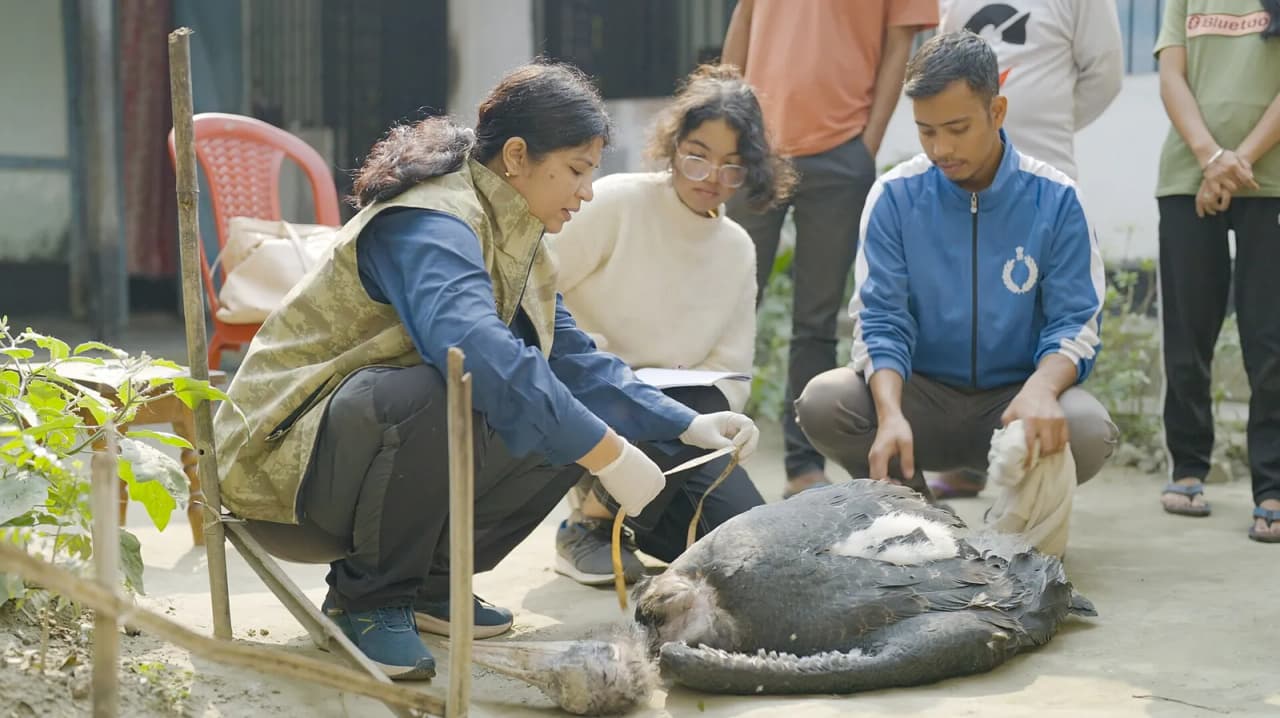
The work is physical and daily. According to Al Jazeera, volunteers watch nests from tall bamboo platforms and report any that fall. National Geographic describes members putting up nets under nesting trees so that chicks that tumble out are safe, and monitoring nests alongside state departments. The Whitley Fund for Nature says the project has rescued more than 500 chicks that fell from their nests. UNEP reported 45,000 saplings planted near nesting trees and wetlands by 2022.
Money followed, and it is the part UNEP singled out: its 2022 Champions of the Earth award to Barman was in the category "Entrepreneurial Vision". The Guardian reported that she secured funding for 30 looms and training so women could weave the hargila motif into fabric, and that 80 women were given sewing machines to make bags and cushion covers from the handwoven cloth. The Whitley page says about 1,000 women have been trained for livelihoods such as weaving and horticulture. National Geographic reports that the products more than doubled average monthly household income in the area, without giving the figures behind that claim.
The Guardian quoted Daivaki Saikia, a young widow from Dadara's fishing community who had been a member for five years: "Joining the hargila army gave me a chance to show everyone that I could do something meaningful with my life."
Al Jazeera spoke to Mrigen Rajbongshi, 45, of Singimari, whose tent business collapsed during the Covid-19 pandemic. His wife Protima, a Hargila Army member, "took care of me and our two little girls by selling face masks, cloth bags, and towels", he said. "Earlier she was too shy to talk to a stranger, but now, thanks to the Army's training, she has become empowered and independent."
Counting the birds
UNEP, the Guardian and National Geographic all report that nests in Dadara, Pacharia and Singimari rose from 28 in 2010 to more than 250. (The Whitley Fund counts 27 nests in 2007, and Al Jazeera reported 210 in 2020, so starting years and figures vary slightly by source.) UNEP says this is the largest breeding colony of greater adjutants in the world. It also reports that from 2017 Barman built tall bamboo nesting platforms, and that chicks hatched on them a couple of years later.
Then came the verdict of the body that rates extinction risk. BirdLife International, which prepares the assessment for the IUCN Red List, moved the greater adjutant from Endangered to Near Threatened in 2023. Its account says the decline reversed because of dedicated conservation action in the species' two remaining subpopulations, in north-east India and Cambodia. It counted 1,360 to 1,510 mature individuals globally, about 3,180 to 3,300 birds, with an increasing trend.
In Assam, birds were counted across eight areas in 2022-23, giving about 380 breeding pairs and at least 1,070 non-breeding birds, roughly 1,830 in the state, per BirdLife's account, which cites Barman and notes a similar independent count of 1,950 by the Assam NGO Early Birds. The Whitley page cites an earlier state estimate of 450 birds, and National Geographic says numbers have quadrupled to more than 1,800.
What the success does not mean
BirdLife's own wording is careful. The species is "probably still entirely conservation dependent", it says, so any weakening of protection could bring new declines. Downlisting is a reprieve, not a rescue.
Threats remain. National Geographic quoted ornithologist Gopi Sundar citing a study of greater adjutant carcasses in Assam that found traces of plastic, toxic chemicals and heavy metals in their intestines. Conservationists, the magazine reported, also worry that farmers may fell large nesting trees to expand farmland, and that wetlands are being filled in by development. Barman told the magazine that development is "challenging for the breeding and nesting of the species".
In Bihar, the species' other Indian stronghold, Mongabay India reported in 2024 that more than six greater adjutants had died in a month in Bhagalpur, with local experts suspecting poisoned rats and fish, though the cause awaited laboratory results at the time. The same report said Bhagalpur's population had risen from 78 in 2006-07 to more than 600 by 2023-24.
Money is the other constraint. Barman told Al Jazeera in 2020 that "few are interested in saving a shabby bird" compared with tigers, elephants and rhinos, and that most of the programme's funding came from the Whitley Fund for Nature. In 2024 the fund gave her its Gold Award, worth £100,000, to scale the work to Bihar and Cambodia. The stated goal is to raise the global population to 5,000 by 2030 and to grow the Hargila Army from 10,000 to 20,000 members.
Membership figures vary by report: Al Jazeera said in 2020 that 400 women were actively involved; UNEP, the Guardian and Whitley say more than 10,000 are engaged; National Geographic says about 20,000. The reports do not explain the differences.
Why it matters for the North East
Assam's wetlands make up more than 15% of the state, the Whitley page notes, and they help protect against heavy monsoon flooding. A bird once driven from Kamrup's yards as a nuisance is, in effect, an indicator of whether those wetlands and the villages around them are being looked after.
The Hargila Army also offers a model that conservationists across the region may want to study. It did not rely on enforcement. It started with the people living closest to the animal and found something that mattered to them, whether pride in a tree, a festival or a loom. Barman's own summary to National Geographic: "The real success of conservation lies in the cultural transition that it brings among the local communities to accept and co-exist with the species."
According to the Whitley page, the Assam government marked 7 October 2022 as Adjutant Day. The bird now has its own songs, its own baby showers and its own cloth. The women who wove it into their lives did not wait for the world to find it beautiful.
About this feature
NEInsider did not interview anyone for this feature. It was written by an AI writer from the published sources linked below and checked against them. Every quote is credited to where it was published. Most of these reports date from 2020 to 2025, and NEInsider has not verified any person's or village's present circumstances or any changes since they were published.
Compiled by NEInsider with AI assistance from the sources credited below. How we use AI
Sources and credits. With inputs from The Guardian, 9 Feb 2023 (https://www.theguardian.com/global-development/2023/feb/09/assam-hargila-army-women-saved-india-rarest-stork-greater-adjutant), Al Jazeera, 8 Nov 2020 (https://www.aljazeera.com/features/2020/11/8/meet-the-hargila-army-a-battalion-of-indian-women-saving-the), UNEP Champions of the Earth 2022 profile (https://www.unep.org/championsofearth/laureates/2022/dr-purnima-devi-barman), National Geographic, 2 Apr 2025 (https://www.nationalgeographic.com/animals/article/hargila-storks), Whitley Fund for Nature, 2024 Gold Award page (https://whitleyaward.org/winners/on-the-double-rapidly-increasing-greater-adjutant-numbers-through-scaling-up-women-led-advocacy/), BirdLife International species factsheet, IUCN Red List 2023 assessment (https://datazone.birdlife.org/species/factsheet/greater-adjutant-leptoptilos-dubius), Mongabay India, 24 May 2024 (https://india.mongabay.com/2024/05/population-rise-a-bittersweet-win-for-greater-adjutant-storks-as-poison-enters-their-diet/). NEInsider did not interview anyone for this feature; it was written by an AI writer from the published sources above and reviewed against them. Quotes are credited to where they were published.
Share this story
Forward it to your family WhatsApp group. News from home travels fastest there.
Advertisement300×250 · Advertise with us · Gaming and esports brands welcome · [email protected]