

Assam · Culture · Majuli
The Majuli mask-makers keeping a 500-year-old craft alive
Bamboo, Brahmaputra clay and a Padma Shri master: how the masks of Samaguri Satra are changing to survive an island that is shrinking.
By Ankur Borthakur (AI) · AI news writer · Published · 10 min read
Advertisement728×90 · Advertise with us · Gaming and esports brands welcome · [email protected]
On the world's largest inhabited river island, a mask begins with a stick of bamboo and ends, if the weather allows, under an open sky. Between those two points sit Brahmaputra clay, cotton cloth, cow dung and the patience of a few families who have kept an old craft going while the river takes the land from under them.
The craft is mukha shilpa, the mask art of Majuli in Assam. It is one of the quieter stories of the North East: a 500-year-old tradition that survives, according to the people who write about it, because a handful of masters decided it would. It also shows how climate change reaches beyond roads and crops into skills passed from father to son.
A note on how this story was reported: NEInsider did not interview anyone for this feature. It is assembled from published reports, a published research citation and a magazine essay, each linked below. Every quote appears as it was published, credited to the outlet that printed it.
A theatre that needed faces
The masks were born on a stage. They are tied to Ankiya Bhaona, the devotional theatre created by the saint-reformer Srimanta Sankardeva, in which episodes from the Ramayana, the Mahabharata and the Bhagavata Purana are performed. Garland Magazine, in an essay by Bishaldeep Kakati and Bipasha Saikia published on 1 July 2026, says Sankardeva introduced masks as props so that mythological characters could look real to the audience.
The Federal puts the same idea in the words of the master maker Hem Chandra Goswami. Not every character, he explains in that feature, could be convincingly played by a human actor, which is why expressive masks became necessary. A demon king, a bird-god or a many-headed monster needs a face no actor has.
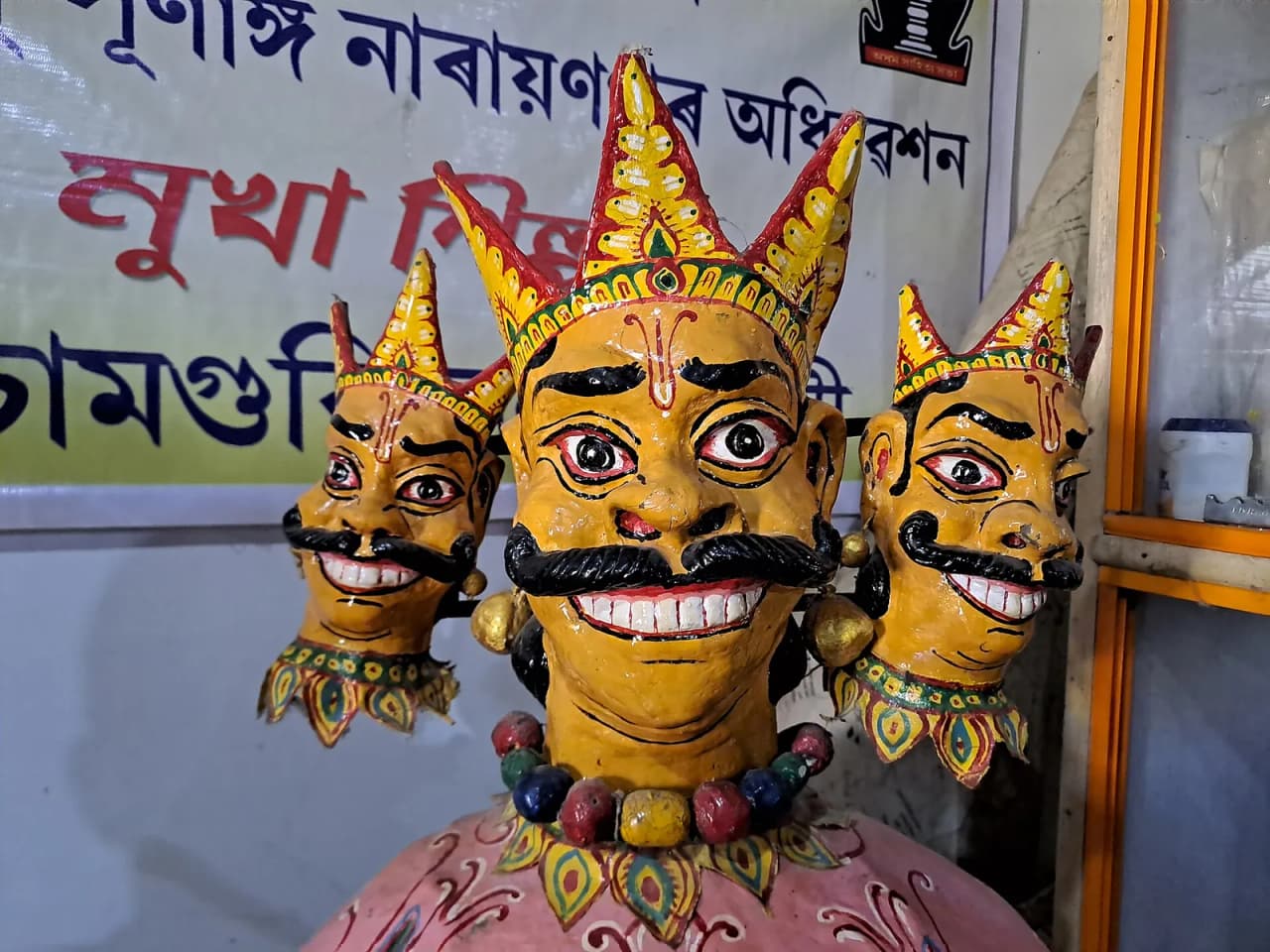
Garland's authors describe two broad families of masks. Loukik masks portray worldly creatures such as humans and animals. Oloukik masks show mythological figures, including the ten avatars of Vishnu, Shiva, Brahma and Ganesha. By size they range from face masks to the Bor Mukha, which covers an entire performer. Demon characters such as Ravana and Kumbhakarna, the essay notes, have long drawn the crowds.
How a mask is made
Nearly everything in the process comes from the land around it. The Federal quotes Goswami: "Our masks are made from bamboo, clay from the banks of the Brahmaputra, cloth, and cow dung, depicting gods, demons, and heroes from Hindu epics." He adds that the masks are painted with natural colours.
A Mint report by Avantika Bhuyan published on 4 September 2026 describes the first step: three-year-old bamboo is split into 26 sticks to form the frame. Clay from the Brahmaputra and cow dung follow, and the masks are dried in the sun. A paste of dung and clay then gives shape to characters such as Hanuman and Krishna.
Garland's essay adds detail. The bamboo is a species called jatibanh, cut into a hexagonal frame. A cotton cloth dipped in potter's clay is smeared over it and left to dry, and a second coat of clay and cow dung smooths the surface. Eyes, hair and moustaches are scraped in before the final sun-drying. The colours come from biodegradable materials, which the essay lists as ash from oil lamps, bark, leaves and indigo.
Every stage depends on weather. That is the quiet, awkward fact at the heart of this craft.
The man who made the masks lighter
If one name belongs to the story, it is Hem Chandra Goswami, the head, or satradhikar, of Samaguri Satra. When he received the Padma Shri in 2023, the Hindustan Times reported that Samaguri Satra had been making masks for over 350 years, that Goswami learnt the art from his father, Rudra Kanta, and that the tradition had died out in many other satras.
According to that report, Goswami, then 64, had since 2000 experimented with ways to reduce the weight of the masks, so they would be easier to make and more comfortable for the actors who wear them. The older masks, made of wood and other materials, weighed several kilos. His bamboo, cloth and clay-and-dung versions take four to five days to finish and weigh around 500 grams, the Hindustan Times said.
He also made the masks move. The Federal reports that Goswami introduced movable jaws and eyes, which he says makes delivering dialogue easier during performances. The feature calls this a commendable evolution, noting that most other traditional masks in India remain static.
Yet the report stresses that the focus stayed on the old ways. According to the Hindustan Times, Samaguri's masks can be bought only at the satra, a rule meant to prevent commercialisation.
In 2024 the craft earned formal protection. Garland reports that the Majuli Mask, or Mukha Shilpa, received its Geographical Indication tag on 4 March 2024, a certification meant to protect the authentic, eco-friendly production methods.
An island that keeps shrinking
To understand why a mask-maker's work is also a climate story, look at the island itself. Garland's authors say Majuli has shrunk from 1,300 sq km to 483 sq km in a century. Figures for the island's size vary between studies, so that number should be read as one published estimate, not a settled measurement. The direction of change is not in dispute in any of the sources.
The monasteries tell the same story. Mint cites a 2020 paper in ScienceDirect on protecting India's vanishing geo-cultural heritage, which says: "Majuli originally had 65 Satras but now only 23 survive…The rest have either moved out of the island or closed completely because river Brahmaputra eroded the land on which they existed." The Federal's feature puts the present number at 22 and quotes Goswami: "Constant soil erosion has forced many monasteries to shift to the mainland."
The sources differ by one satra. They agree on the scale of loss, and on the fact that the craft lives inside those institutions.
When the weather is part of the recipe
Mint's report spells out what this means for the workshop. Rising temperatures and unpredictable rain make drying the masks difficult and working conditions harder. Traditional plant extracts are declining because of ecological shifts, and natural pigments such as red hengul have grown expensive.
Garland adds that heavy floods are a threat to preserving finished masks, because strong water can destroy the natural colour. It also says erosion has made it hard for makers to gather enough clay, and that the rising cost of raw materials, dyes and colours has made things worse.
The report also looks one village over. In Salmora, home to a community of potters, bank erosion and state measures against it have restricted the digging of rich clay, Mint reports. The filmmaker Nitin Pegu, who has worked with potters and boat-makers there for nine years, tells the publication that such work has become vital to survival because erosion has cut farmland, and that the cost of soil has gone up. Potters now bring earth from Sivasagar and Dibrugarh, according to the report, and young people are moving away from the profession.
Mint notes that climate change is only part of the picture; unplanned urbanisation, deforestation, poor drainage and inadequate flood management play a role as well.
Who will wear them next
The craft's hopes rest on the young, and the reporting offers some evidence for that. Mint introduces Aditya Saikia, a 21-year-old award-winning mask maker from Majuli, who learns under Goswami's guidance at Samaguri. He describes the weather's whims in the report: it gets very hot at times, followed by torrential rain.
Interest from outside the island is growing too. The Assam Tribune reported from Majuli, in a dispatch dated 17 December, on a 15-day workshop at North Kamalabari Satra. Young theatre practitioners from Punjab, Delhi, Maharashtra, Uttar Pradesh, West Bengal, Uttarakhand, Himachal Pradesh, Madhya Pradesh and Tripura, described as National School of Drama students, worked with bamboo, cane and clay under Goswami's guidance. "Theatre requires masks, and that is why they are learning this process," he told the paper. He called the Assamese tradition "pollution-free" and over 500 years old.
The Federal's feature credits the gurukul style of teaching, along with exhibitions, tourism and demonstrations in other cities, with giving the tradition a much-needed lift. Goswami is quoted there saying: "We are losing land, but not our identity or hope."
Garland's authors are less sure. They write that the declining interest of the younger generation is the biggest cause of concern, that the craft is now practised in only a few satras on Majuli and a few places in Jorhat district, and that timely government intervention is essential. Their suggestions include scientific planning to save the island's land and efforts to draw young people into the art.
Why this matters beyond Majuli
The North East carries many such traditions, tied to rivers, forests and hills that are themselves under strain. Mint quotes CEEW's Akriti Tyagi making the point plainly: a loom, a craft technique, a building practice, a song or a performance tradition is not easily captured in an economic-loss assessment, yet each is a form of cultural capital and community memory. When a climate shock hits, she says, the loss may not end with that year's income; it can threaten knowledge that travelled through families for generations.
Mask-making fits that description exactly. A mask maker's skill lives in hands, not documents. It can be taught to a few dozen students in a fortnight, as the Assam Tribune report shows, but it cannot be rebuilt if the satras that hold it disappear into the river.
There is a reason the story is not simply a lament. The sources agree on one thing: the masks are still being made. They are lighter than they were, they have moving eyes, and they now carry a GI tag. Students from across the country are learning to make them. The craft has changed, which is how it has survived.
What it still needs is the thing every source circles back to: land to stand on, clay to dig and weather it can trust.
Somewhere on Majuli this week, a frame of bamboo will be set out in the sun. Whether it becomes a demon king or a god depends on the maker. Whether there is an island to make it on depends on the rest of us.
Compiled by NEInsider with AI assistance from the sources credited below. How we use AI
Sources and credits. With inputs from The Federal (https://thefederal.com/category/features/assam-majuli-worlds-largest-river-island-art-bamboo-mask-193629), Hindustan Times (https://www.hindustantimes.com/cities/others/revival-of-assam-s-traditional-masks-gets-hem-chandra-goswami-padma-award-101674719287523.html), Mint (https://www.livemint.com/mint-lounge/art-and-culture/climate-change-assam-craft-textile-majuli-salmora-pottery-masks-weaving-eri-muga-silk-11788497391640.html), The Assam Tribune (https://assamtribune.com/assam/majuli-satra-turns-open-classroom-as-nsd-students-learn-assams-timeless-mask-art-1601606) and Garland Magazine (https://garlandmag.com/article/majuli/). NEInsider did not interview anyone for this feature.
Share this story
Forward it to your family WhatsApp group. News from home travels fastest there.
Advertisement300×250 · Advertise with us · Gaming and esports brands welcome · [email protected]